


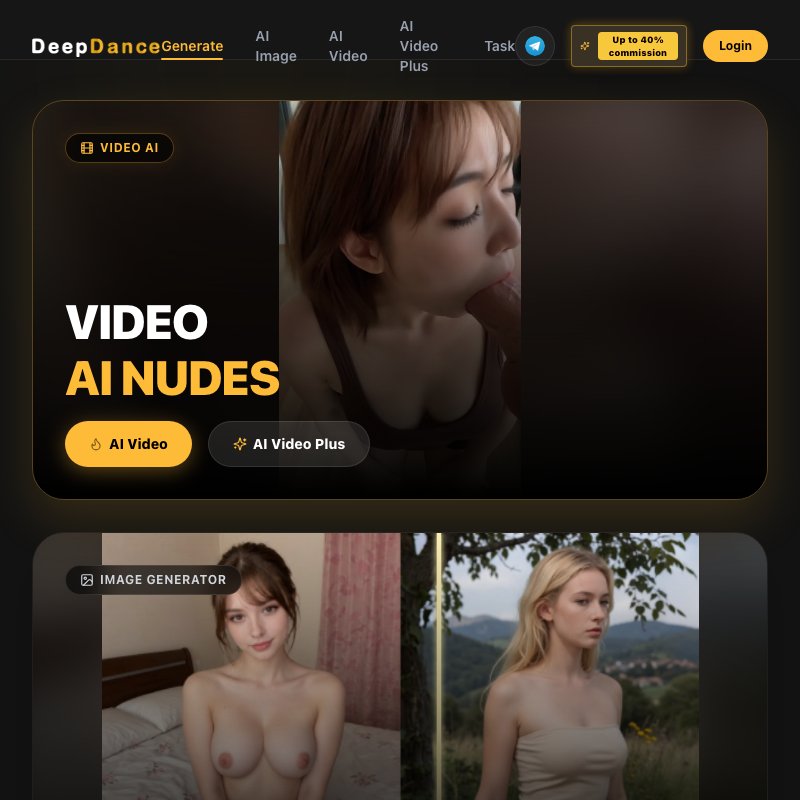
You quickly discover that DeepDance positions itself as the all-in-one sandbox where those two domains collide. The site promises a unified browser-based studio for creating explicit fantasy content through image generation, video tools, face swapping, and comprehensive editing, all without forcing users to juggle separate platforms or install desktop software. It leans into creation rather than passive consumption, presenting a minimal landing page that signals seriousness instead of flashy previews. No long sales copy, no fake testimonials, just clear navigation to the core tools. The implicit claim is convenience wrapped in technical competence: start with a prompt or template, refine across modalities, and output coherent explicit scenes that range from static portraits to animated sequences.
How DeepDance Works
The workflow is deliberately straightforward. A user registers an account, lands in a clean dashboard, and chooses between image or video creation paths. Text-to-image generation accepts detailed prompts or begins from the site's template library, which supplies pre-built styles and scenarios to bypass blank-page paralysis. Once an image exists, it can feed directly into video tools that add motion, face swap for identity transfer, or the editing suite for targeted adjustments. Generation happens in the cloud; results appear in the member area where they can be iterated upon or downloaded.
The process rewards iteration. A basic image might take seconds, while video clips demand more credits and patience depending on queue priority. Public information indicates the platform handles NSFW content without heavy built-in censorship, allowing explicit anatomy and scenarios provided they remain within fantasy parameters using consenting models or fully synthetic creations. Limits exist on the free tier, queues form during peak times, and output consistency improves with refined prompts or template starting points. The entire loop lives in one dashboard, which is the site's primary selling point for users tired of fragmented tools. Registration requires only an email and age verification, nothing unusually intrusive. No desktop app is needed; it runs in modern browsers on both desktop and mobile, though complex video jobs clearly favor larger screens and stable connections.
Image Generation Engine
DeepDance devotes significant resources to its text-to-image and image-to-image pipelines. The system produces high-resolution explicit stills with attention to anatomy, lighting, and stylistic variety. Public galleries and review descriptions show realistic skin textures, diverse body types, ethnicities, and poses that span soft eroticism to outright hardcore. Prompt adherence is generally strong when users leverage the template library, which appears to encode reliable NSFW starting points rather than forcing users to master arcane keywords.
That said, the critic in me notes the familiar AI fingerprints: occasional finger artifacts, inconsistent eye direction in complex compositions, and slight softening of fine details at the highest resolutions. The engine shines brightest with pure synthetic characters rather than heavy face-swapped realism. Output quality sits comfortably in the upper tier of current consumer tools, realistic enough to suspend disbelief in fantasy contexts yet not indistinguishable from professional photography. Generation speed on paid tiers feels responsive, while free users report longer waits and lower daily limits. No watermarks appear on paid output, a welcome professional touch. The variety in styles, from photorealistic to stylized erotic illustration, gives the image side genuine range without forcing a single aesthetic.
Video and Motion Capabilities
The video tools represent DeepDance's most distinctive offering and tie directly into the "dance" nomenclature. Users can animate still images into short clips featuring fluid movement, including dance-like choreography, body motion, and explicit action sequences. The process typically starts with a generated or uploaded image, selects a motion template or describes desired movement, and lets the model synthesize frames. Results are short clips, often in the 5- to 15-second range, with decent temporal coherence for simple motions.
Realism in motion remains the weak point, as expected in 2026 consumer AI. Complex dance sequences or rapid explicit activity can introduce warping, flickering limbs, or unnatural weight shifts. Simpler undressing-style reveals or slow sensual movement fare better, maintaining anatomical plausibility across frames. The platform's strength lies in its integration: an image created in the first module flows seamlessly into video generation without re-uploading or reformatting. Reviewers note that the template library helps here too, offering reliable motion starters that reduce the prompt engineering burden. Output resolution reaches HD levels on higher tiers, with acceptable frame rates for personal use. It is not cinema-quality animation, but for private fantasy clips it delivers competent results that earlier generations of these tools could not match. Artifacts become more pronounced the longer or more ambitious the clip, encouraging users to keep generations short and targeted.
Face Swap and Identity Control
Face swap functionality sits at the intersection of the image and video pipelines. Users upload a reference face (always framed as belonging to consenting performers or synthetic creations) and apply it to generated bodies or existing templates. The tool handles skin tone matching, lighting consistency, and angle adaptation with above-average competence. In explicit contexts this allows personalization of fantasy scenarios while keeping the body physics and anatomy rooted in the platform's stronger synthetic models.
Quality varies with source material. Well-lit, front-facing reference images produce convincing swaps; extreme angles or low-resolution selfies introduce blending artifacts around hairlines and necks. When chained into video, the swapped face can drift or lose fidelity across frames, a common limitation the editing tools later attempt to mitigate. DeepDance does not market this as a deepfake instrument for real individuals without consent; the documentation and surrounding copy emphasize fantasy entertainment and synthetic characters. This restraint is refreshing in a category rife with ethical gray areas. The feature works best as a finishing touch rather than the foundation of a project, allowing users to refine a strong base image or clip rather than forcing every generation through the swap module from the start.
Editing Suite Plus Template Library
The editing tools unify the experience. Inpainting, outpainting, pose adjustment, and targeted refinement let users correct artifacts, change expressions, adjust anatomy, or enhance specific regions without regenerating entire pieces. The template library deserves separate praise: instead of starting from a blank prompt, users can browse hundreds of pre-tuned scenarios, styles, and motion starters. This accelerates workflow dramatically for iterative creators who want to experiment rather than write novels in the prompt box.
Combined with the dashboard's history and variation features, the editing suite turns one-off generations into iterative projects. A user might generate a base image, swap a face, animate a short dance sequence, then edit individual frames or upscale the final output. The presence of all these functions in one interface eliminates the friction that plagues multi-site workflows. Limitations remain, primarily around credit consumption. Heavy editing sessions can burn through balances quickly on lower tiers. Still, the technical integration feels thoughtful rather than bolted together as an afterthought.
Platform Design, Speed and Responsiveness
Visually, DeepDance adopts a minimalist, professional aesthetic that ironically distances itself from the sleazy reputation of older adult generators. Dark mode defaults, clear iconography, and logical sidebar navigation make the member area feel more like a creative workstation than a porn site. Mobile responsiveness is adequate for browsing and light generation, though video preview and detailed editing clearly favor desktop. Load times are snappy, queue visibility is transparent, and the dashboard organizes projects cleanly so users can return to previous experiments without digging through downloads.
Technical requirements are modest: modern Chrome or Firefox recommended, with no exotic browser dependencies noted. Speed scales with spending. Free and basic users encounter queues and slower generation during busy periods; VIP tiers unlock priority processing, higher concurrent jobs, and presumably better model versions. No public changelog or blog was prominent in research, suggesting the team focuses on product stability over marketing theater. FAQ and support links exist but appear limited to standard topics; deeper troubleshooting likely lives behind login.
Pricing, Free Tier and Policies
DeepDance operates on a credit system referred to as Stars, with a free tier offering limited daily generations, longer queues, and possible watermarks. Paid plans and one-time credit bundles unlock faster processing, higher limits, removal of restrictions, and full access to premium features. VIP subscriptions provide the best value for heavy users by combining priority queuing with increased monthly allotments. Exact dollar figures and credit consumption rates are not exhaustively detailed in public pages, but the model follows industry norms: entry-level access is cheap enough to test the platform, while serious creators will migrate to higher tiers quickly. Payment methods are standard for the category.
Policies emphasize 18+ use only and frame all content as fantasy entertainment. The platform discourages non-consensual applications and states that accounts risk suspension for abuse. Privacy language appears standard; generated content is not publicly searchable, and users retain ownership of their outputs within the terms. No refund policy details stood out in public documentation, suggesting buyers should treat credit purchases as final. These positions align with responsible operators in the space while acknowledging the explicit nature of the tools. Red flags are relatively few: the minimal public documentation means new users must learn through trial, and video quality still trails static images, but neither qualifies as deceptive.
Final Verdict
DeepDance delivers on its core promise as a unified creative environment for explicit AI fantasy. It is not the absolute best single-purpose image generator, nor does it produce flawless video choreography, yet the frictionless movement between image creation, motion synthesis, face swapping, and editing creates genuine workflow advantages that fragmented competitors cannot match. For users whose interests span static scenes, animated sequences, and personalized fantasy without constant context switching, the platform earns its place. The ironic distance of its minimalist design only heightens the sense that this is a tool for adults who know what they want rather than a toy for the easily impressed.
Those seeking perfect realism in complex dance or explicit motion will still encounter the current limitations of consumer AI, and the credit system rewards disciplined prompt engineering over brute-force generation. Within those constraints, DeepDance stands as one of the more thoughtfully assembled studios currently available. If your workflow benefits from templates, integrated pipelines, and a no-nonsense interface, it merits testing. The free tier provides enough access to evaluate whether the all-in-one convenience justifies moving to paid credits. In a crowded market full of noisy promises, that honesty is rarer than perfect anatomy.